

Dr. Pen Official Store
Dermapen 4 Needles 16 Pins — 100pcs
Dermapen 4 Needles 16 Pins — 100pcs
Couldn't load pickup availability
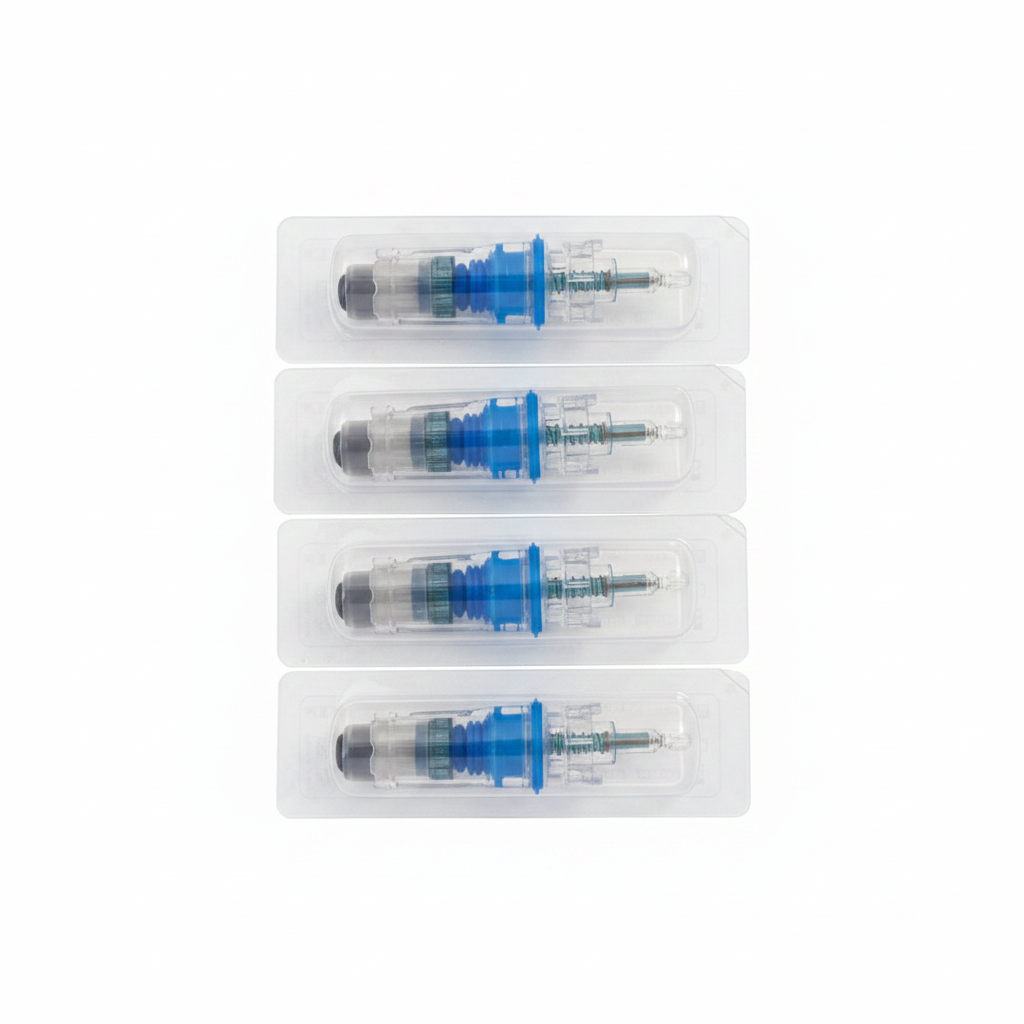
16-needle cartridges for the Dermapen 4, individually sealed and single-use. The Dermapen 4 takes one cartridge format and one only — the 16-needle — so there is nothing to choose here.
Running the 16-needle format
The 16-needle arrangement is the one this device is built around: enough needles to cover a zone in few passes, spaced so the cartridge glides rather than drags. On a face it suits texture, pores, fine lines and infusion work; on the neck, jawline and décolletage it covers ground quickly; and for body or scalp protocols it is the format the device offers, so it is what you use there too.
Will these run in your Dermapen 4?
Start with how the cartridge seats, because most "it will not start" calls are a seating problem rather than a cartridge problem. The drive-ball end goes into the pen, and the cartridge locks with a quarter-turn clockwise. The motor will not run without a cartridge installed, and if it is not locked properly the cartridge symbol flashes on the display and the pen stays switched off.
One patient, one cartridge
Every cartridge in the pack is individually sealed and single-use. Open a fresh one for each patient, and dispose of it as clinical waste when the session ends.
- Check the seal before you fit it. If a blister has been crushed or opened in transit, set that cartridge aside rather than using it.
- Do not reuse or re-sterilise. A cartridge that has been on skin is blunted and no longer as supplied; putting it back in its sleeve does not change that.
- Store the pack cool and dry, out of direct sunlight, and read the date on each blister before use. A bulk pack is a stock item, so store it like one.
Complete Your Microneedling Setup
❓ Frequently Asked Questions
The pen will not start with one of these loaded — what should I check?
Seat it again first. The drive-ball end goes into the pen and the cartridge locks with a quarter-turn clockwise; the motor will not run without a cartridge installed, and if it is not locked correctly the cartridge symbol flashes on the display and the pen stays off. So check the lock and the seating before you suspect the cartridge. Then check the seal — if the blister was damaged in transit, set that one aside. This is exactly why we suggest testing one cartridge from the pack before opening the rest: if the first one does not run, contact us with the order number and do not open the remainder.
How many treatments will a 100-pack cover?
A standard facial protocol runs 1–2 cartridges per session, so somewhere between fifty and a hundred facial sessions. Face plus neck or décolletage pushes you to the upper end of that, and body or scalp work adds cartridges on top, so those diaries get through a pack faster. Because every cartridge is single-use, the pack is consumed at exactly your session rate — which means the useful way to size it is to count last month's sessions and multiply, not to guess at what looks like a good deal on a shelf.
Can I put a part-used cartridge back in its sleeve for the next client?
No. Single-use means one patient, one cartridge. Once it has been on skin the needles are blunted and the cartridge is no longer as supplied, and returning it to its sleeve does not restore either. If a session ends early, that cartridge is still spent. A part-used cartridge is a hygiene problem and a drag problem, not a saving — and on a bulk pack the arithmetic does not argue for it anyway, because the cost per cartridge is the lowest it will be.
Which depth should the 16-pin cartridge be run at?
Depth is set on the pen, not chosen by the cartridge — the same cartridge runs at 0.5 mm and at 3.0 mm, so this is a protocol decision rather than a purchasing one. As a working frame: 0.5–1.0 mm for facial texture, fine lines and product infusion; 1.0–1.5 mm for the neck and décolletage; and deeper settings only where your training and your protocol support them — the needle depth guide linked above sets out the full picture.
Share