

Dr. Pen Official Store
Dr. Pen A1 Replacement Cartridges
Dr. Pen A1 Replacement Cartridges
Couldn't load pickup availability
Both A1 handpieces take the same cartridges, so one set of heads covers the pen you have. Fit them to an A1 only: the A6 takes a separate cartridge system.
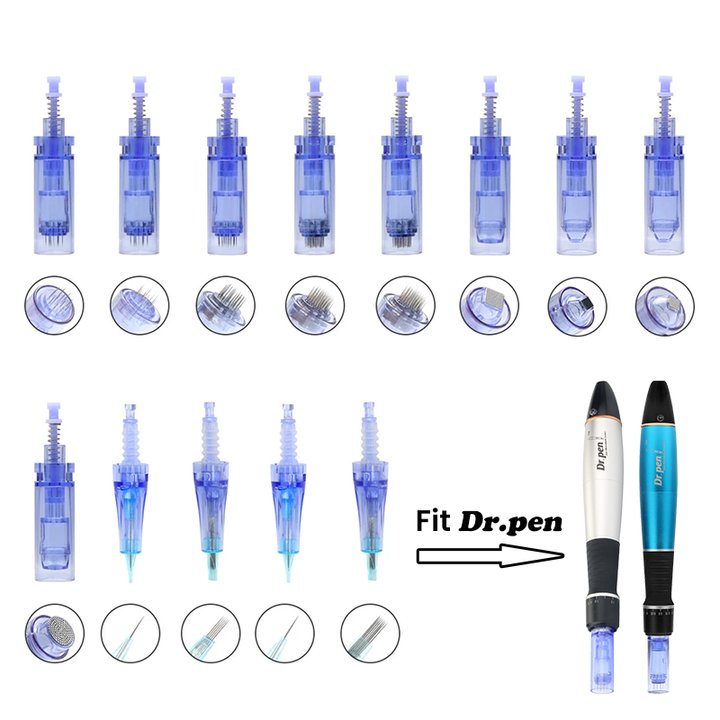
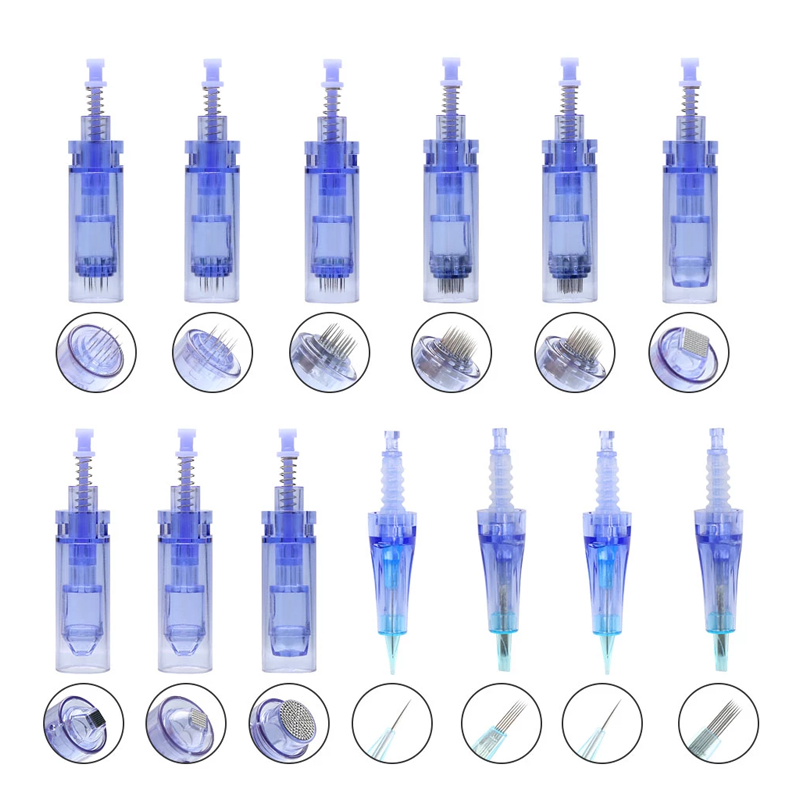
Thirteen heads, in two families
This is the widest single range Dr. Pen sells for one pen, and it is really two toolkits in one box: heads that draw a line with pigment, and heads that make channels across an area. Depth is set on the pen — the A1 depth dial runs from 0 to 3.0 mm — and the head decides which job you are doing.
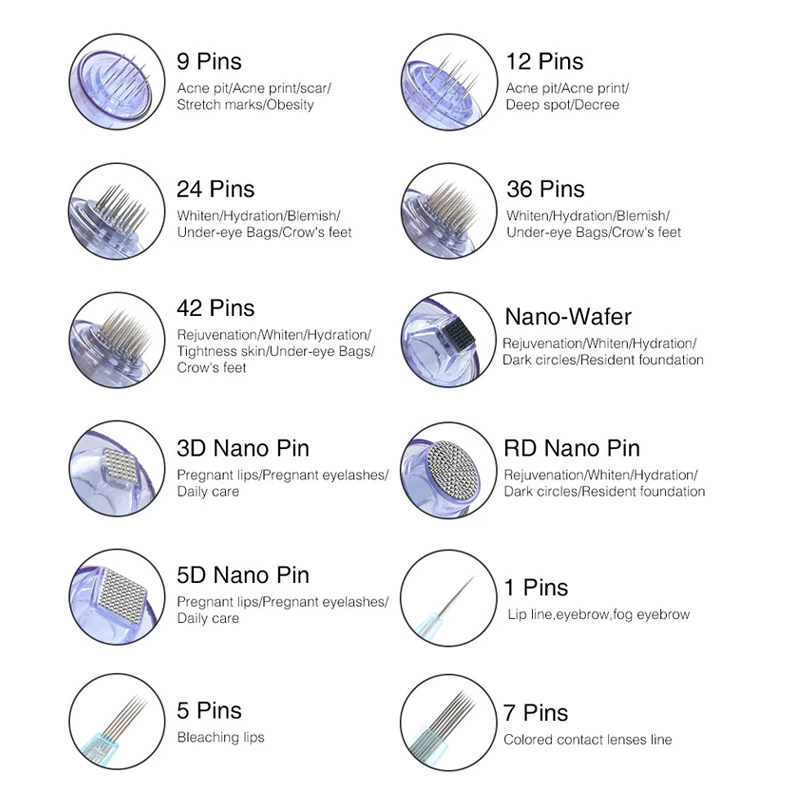
| Head | Best for | Typical depth |
|---|---|---|
| 1-pin | The finest pigment head — one point, for the tightest detail in a pigment protocol | Pigment protocol — shallow |
| 3-pin | A small pigment head — the middle option between single-point work and the 5-pin | Pigment protocol — shallow |
| 5-pin | A pigment head with a little more width — outlines and small areas that need a steadier line | Pigment protocol — shallow |
| F5 | A flat pigment tip — for filling a small area evenly rather than drawing a line | Pigment protocol — shallow |
| F7 | The second flat tip in this range — the same kind of job, in the other configuration | Pigment protocol — shallow |
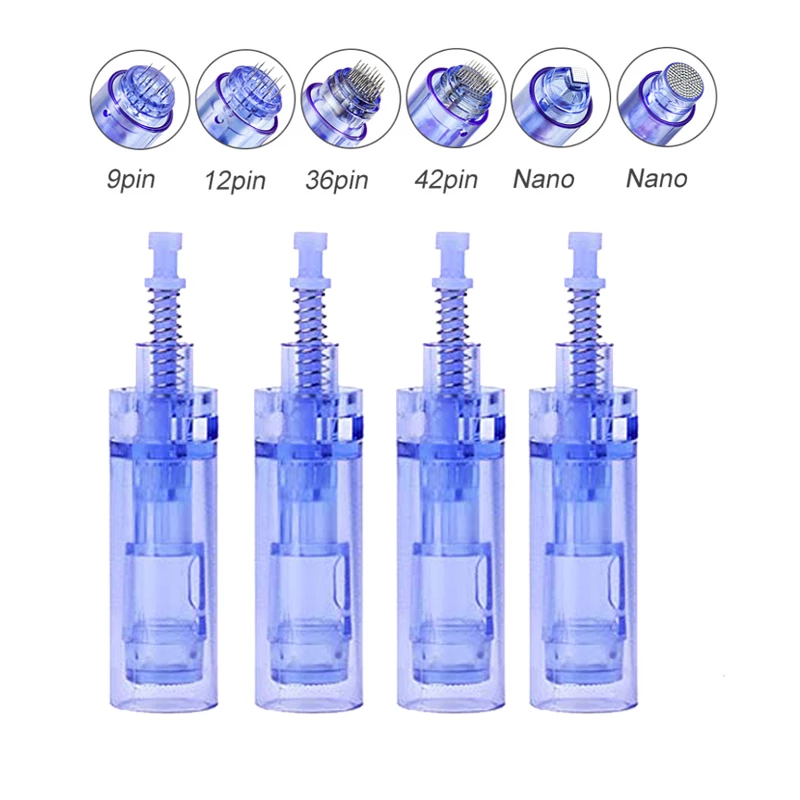
| 9-pin | Needling detail — a single line, a narrow strip you can follow closely | 0.25–0.5 mm |
| 12-pin | The standard facial head — targeted passes across the face | 0.25–1.0 mm |
| 24-pin | Whole-face coverage with fewer passes per zone | 0.25–1.0 mm |
| 36-pin | Neck, jawline, décolletage and the body — larger areas, fewer passes | 0.5–1.5 mm |
| 42-pin | The widest needling head in this range — the fastest way across a big area | 0.5–1.5 mm |
| Round Nano | No-needle surface work — pressing a serum in, under-eye, weekly upkeep | ≤ 0.25 mm — no needles |
| 3D | The three-dimensional nano tip — glides a serum through the contours of the face | ≤ 0.25 mm — no needles |
| 5D | The multi-angle nano tip — the widest of the three nano surfaces | ≤ 0.25 mm — no needles |
Safe depth by concern is in our needle depth guide — at home, keep facial depth at or below 1.0 mm; above 1.5 mm is for trained practitioners.
Telling a pigment head from a needling head
Both families live in the same listing, and they do different work, so it is worth knowing which is which before the box arrives. The rule is the shape of the head, not the number on it:
- Pigment heads — 1, 3 and 5-pin, F5 and F7. Single points and flat tips, built to place pigment in a line or fill a small area. Shallow depth, tight control.
- Needling heads — 9 to 42-pin. Grids of needles that make micro-channels across an area. This is the group that covers a face, a jawline or a body zone.
- Nano heads — Round Nano, 3D and 5D. No needles at all. Surface work only.
You can run a pigment protocol and a needling routine from the same pen, but not from the same cartridge — a head is used once and then replaced. Our cartridge guide covers how the needling grid sizes behave if you are choosing between the 12, 24, 36 and 42.
Before your first session with the A1
- One sterile blister per head, with manufacturing and expiry dates printed on it.
- Single use. A head is spent when the session ends — see can you reuse Dr. Pen cartridges?
- A listing you can verify. We are an authorised Dr. Pen retailer and stock arrives through the official supply chain — how to verify your Dr. Pen.
Complete Your Microneedling Setup
❓ Frequently Asked Questions
What are the 1-pin, 3-pin and 5-pin heads for?
They are the pigment heads, and they work on a different principle from the needling grids: instead of making channels across an area, they place pigment along a line. The 1-pin is the single finest point for detailed work; the 3-pin sits between; the 5-pin gives a slightly wider, steadier line. All three run shallow. If you do not do pigment work, none of them belongs in your order.
What is an F5 or F7 head used for?
F5 and F7 are the two flat tips in this range — pigment heads for filling a small area evenly, rather than for drawing a fine line. Whether F5 or F7 suits a given protocol comes down to the width you want to cover. If you are not sure which of the two to order, tell us what you are working on and we will point you at the right one.
Do the corded A1 and the A1-W use the same heads?
Yes. Both handpieces take the same A1 cartridge range — the pigment heads, 9 through 42-pin needling heads and the three nano heads. What differs between them is how the pen is powered. If you own both, one set of cartridges covers both pens, and there is no need to keep two separate stocks.
Can I use one A1 pen for both face work and pigment work?
The pen, yes — the cartridge, no. Fitting a pigment head turns the same handpiece into a pigment tool, and fitting a 12-pin turns it back into a needling pen. What you cannot do is run both jobs with one head: every cartridge here is single-use, so a pigment head and a needling head are two separate heads, changed between sessions and never reused.
Which A1 heads should I add to the range first?
If you are needling only: the 12-pin for the face and the 24-pin for a faster pass, then the 36-pin if you work the neck or body, and a Round Nano for the finish. If you are doing pigment work as well, add the 3-pin or 5-pin for lines and one flat tip for filling. Start with the head you will use every session — usually the 12-pin — rather than buying one of everything.
Will A1 cartridges fit the Dr. Pen A6?
No — in either direction. The A1 and the A6 are two different pens on two different cartridge systems, and the head names are close enough that this is easy to get wrong when you are ordering. Go by the model on the pen: an A1 head will not seat on an A6, and an A6 head will not seat on an A1. If you own both pens, keep the two packs separate. And if the pen in front of you turns out to be an A6, order from the A6 cartridge range instead of this one.
Share