

Dr. Pen Official Store
Hydra Pen H6 Replacement Cartridges
Hydra Pen H6 Replacement Cartridges
Couldn't load pickup availability
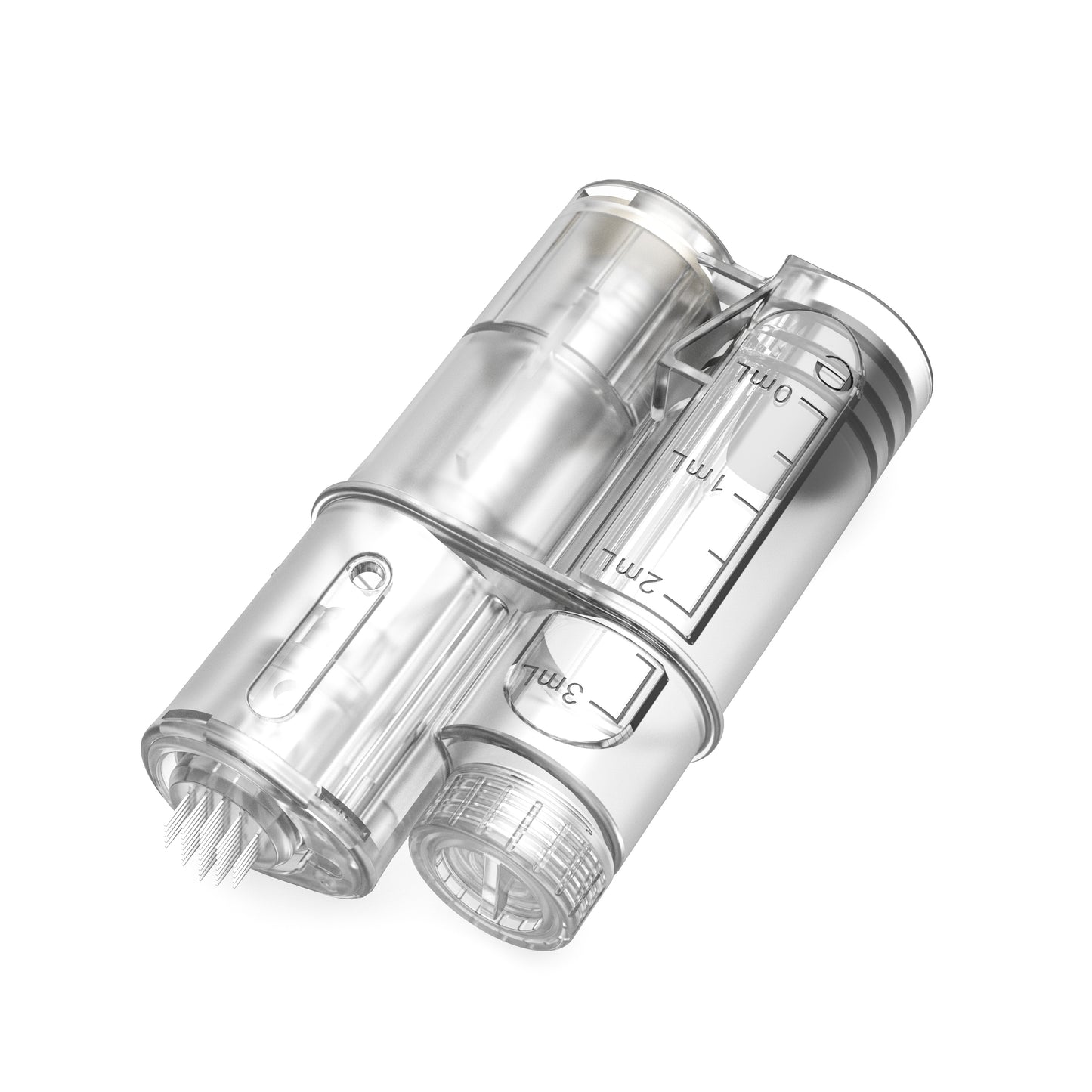
These are the heads made for the Hydra Pen H6. An H6 head is not only needles. It carries a 3 mL reservoir that the pen feeds from as it works, so the serum travels with the head instead of drying on the skin between passes. The reservoir arrives empty — what goes into it is your decision.
The four heads, and where each one lands
Depth is set on the pen — the H6 dial turns from 0.25 mm up to 2.0 mm — so what a head decides is the density of the micro-channels created in one pass, and how the serum is laid down along it. The Nano-R is the exception: with no needles in it, depth does not apply to it at all.
| Head | Best for | Typical depth |
|---|---|---|
| 18-pin | The tightest head in this range — working to a line rather than a region, and getting the serum exactly where you want it | 0.25–1.0 mm |
| 36-pin | The middle of the range and the one most owners come back for — whole-face passes at facial depth | 0.25–1.5 mm |
| 42-pin | The widest head here — cheeks and jawline in fewer passes, and the one that can keep up when you are covering the neck as well | 0.5–1.5 mm |
| Nano-R | No needles — the head for pressing serum into the surface, working the under-eye area, and the light finish at the end of a session | No needles |
Safe depth by concern is in our needle depth guide — at home, keep facial depth at or below 1.0 mm even though the pen will go to 2.0 mm; the deeper end of the range is for trained practitioners. Still deciding between two densities? Our cartridge guide walks the same choice through in more detail.

The reservoir arrives empty — that is the point
A sealed head has to sit on a shelf until you use it, and a head that shipped with liquid already inside it could not. So the 3 mL chamber comes dry and you fill it, which also means the choice of what goes into your skin stays with you rather than with whoever packed the box.
The pen then pushes that liquid through as the head moves, which is the difference between an H6 and a needling-only pen: you are not stopping every section to reapply by hand, and the serum is not drying on the surface while you work elsewhere. The same feature is why the head does not need a second product on the skin to glide.

What goes in — and what stays out
- Use a sterile product made for micro-needling. A session opens channels in the skin, so what you load matters: choose a serum or ampoule formulated for this use rather than an everyday cosmetic one.
- Avoid jarred skincare, however good it is. Jarred products are not sterile to begin with and pick up more each time they are opened, and they carry preservatives and fragrance that have no business in a fresh channel.
- Never let a dropper touch your skin, then go back into the bottle — that is how a clean product stops being one.
- Fill it full before you start. It is far easier to load a head at the beginning of a session than to top one up with serum on your hands.
Filling it, and keeping it flowing
- Clear the air first. After filling, hold the head upright and tap the serum side the way you would tap a syringe — a trapped bubble is the usual reason a head looks full but delivers nothing.
- Work at 90°. The feed is built to run with the head square to the skin, so tilting it is what produces the dripping and the uneven coverage.
- Start on the lowest flow setting and come up. Rising through the settings is also how you find where a given product runs best for you.
- Expect a change in sound as it empties. The pen starts to make a wet, sucking note as the chamber runs low — treat that as the cue to top up rather than running dry.
- Refilling mid-session is normal. The chamber can be refilled during a session, so a top-up is routine rather than a sign that something is wrong.
How far a 3 mL reservoir goes
For a full-face pass, 3 mL is normally the whole session's worth. Because the head lays the serum down as it travels rather than you reapplying by hand, very little of it is lost to the air or to your fingers, and that is what makes a chamber this size go as far as it does.
How far it actually stretches is not fixed, though — it depends on the flow setting you choose and on how much you work beyond the face.
What a sealed H6 pack looks like
- One sterile blister per head, with manufacturing and expiry dates printed on it.
- Single use. A head is spent when the session ends — a reused one drags rather than cutting clean channels, see can you reuse Dr. Pen cartridges?
- A listing you can verify. We are an authorised Dr. Pen retailer and stock arrives through the official supply chain — how to verify your Dr. Pen.
- Packs of 5, 10 and 20. If you treat on a regular schedule, the larger pack is the one that brings the cost per head down.
Complete Your Microneedling Setup
❓ Frequently Asked Questions
Do these heads arrive with serum already in the reservoir?
No. The chamber is empty and dry when the pack reaches you, and every head in the pack is the same. This is deliberate: a filled head would have a shelf life decided by whatever was put in it, and it would also take the choice of product away from you. Filling it yourself takes a moment at the start of a session and is covered in the section above.
What can I load into an H6 reservoir?
A sterile product intended for micro-needling — a serum or ampoule formulated for this use, in a sealed vial. The reason is not fussiness: the head is opening channels in your skin, and a jarred cosmetic carries preservatives, fragrance and whatever it has picked up since it was opened. Those are poor things to push into a fresh channel, and the same reasoning applies to a dropper that has touched skin and gone back into the bottle.
Is 3 mL enough to get around a whole face?
In the normal case, yes — a full-face pass is what a full chamber is sized for, and because the head applies the serum as it travels rather than you reapplying by hand, losses along the way are small. It is not a fixed number, though. How far a chamber stretches depends on the flow setting you pick and on how much you work beyond the face, so a face plus jaw, neck and décolletage is more than one chamber. Load it full before you start, and if you are topping up on every session, drop the flow setting a notch before changing anything else.
The serum is coming out too fast, or barely at all — what should I change?
Work through three things in order. First the flow setting: start low and come up rather than starting high and trying to work quickly. Second the angle — the feed is built to run with the head square to the skin at 90°, and tilting it is what produces dripping and patchy coverage. Third, air: a bubble trapped at the top of the chamber is the usual reason a head looks full but delivers nothing, and holding it upright and tapping the serum side clears it the way you would with a syringe. If a product is heavy, expect to run it at a higher setting than a light one.
What is the Nano-R head, and does it have needles in it?
It has no needles. Nano-R is the head in this range that works on the surface rather than below it, which makes it the one for pressing a serum in where a needling head would be too much — the under-eye area, the upper lip, and the light finish once a full session is done. Because there are no needles, no depth setting will change how it behaves, and it is not a lighter version of the 36-pin. Keep it in the drawer for the days between deeper sessions.
Will these heads fit a Hydra Pen H3 or H5 as well?
No. The H6 uses its own H-series infusion cartridges, and the H3 and H5 share a different system between themselves — so a head from this listing is an H6 head and nothing else. Fitting one to another model is the most common way a mount gets damaged, and it is also the usual reason a pack comes back to us unopened. If you own more than one Hydra Pen, check the family name rather than the shape of the pen before you order; our cartridge compatibility guide lists which models group together.